
Example builds › L&S Excavation › Services › Forestry Mulching & Brush Clearing
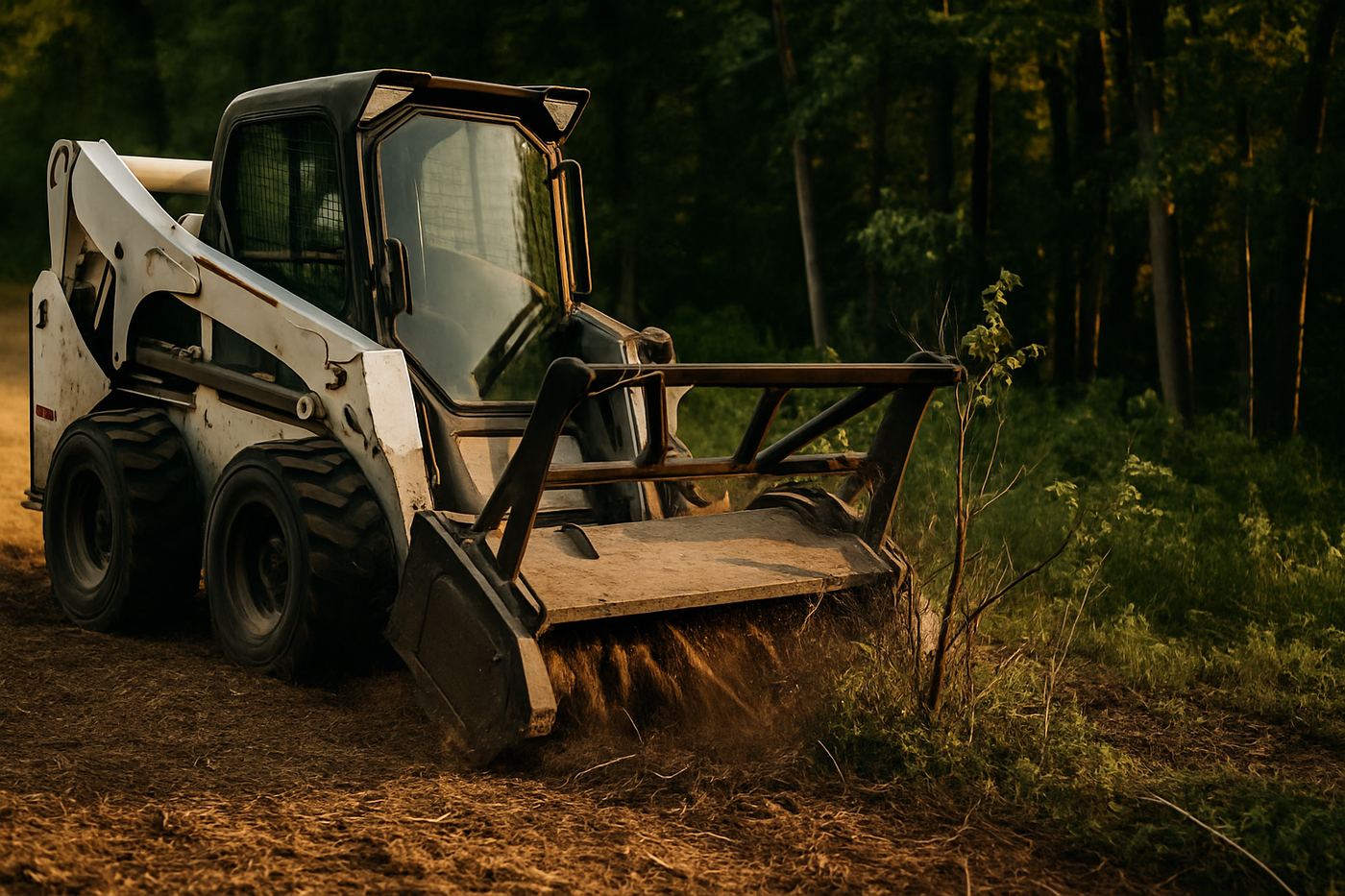
Not every overgrown lot needs a bulldozer. For lots where the goal is to clear underbrush, small trees, and vines without scarring the earth or removing the trees you want to keep, forestry mulching is the right tool. We run a tracked mulcher across the Greater Chattanooga area for property reclamation, right-of-way maintenance, view corridors, pasture renewal, and fire-break creation. The mulcher grinds the standing vegetation in place — what comes out is a clean, level surface of wood chips that protects the soil and decomposes naturally.
What forestry mulching does
A tracked forestry mulcher uses a horizontal-axis drum with carbide teeth to grind standing vegetation — saplings, brush, vines, briars, broom sedge, and trees up to roughly 8 inches in diameter — into a layer of mulch that stays on the ground. The result is:
- A walkable, drivable surface immediately after the work
- A natural mulch layer that suppresses regrowth for a season or more
- No spoil to haul off — the material is left in place
- Minimal soil disturbance because there's no grubbing, no piling, no burning
When to choose mulching vs. traditional land clearing
Mulching is the right call when:
- You want to keep mature trees but remove the understory
- The lot is too steep or wet for conventional clearing
- You don't want stumps and spoil piled or hauled
- You need the area usable immediately (no stump holes, no rough grade)
- You're maintaining a clear right-of-way, fence line, or trail
Traditional land clearing is the right call when:
- You're prepping for a building pad and need the trees and stumps gone
- You need a finish grade after clearing
- The trees are large enough that mulching is impractical
- You want bare earth, not mulch cover
We do both, and we'll tell you which fits the project.
Typical projects
- Lot reclamation for properties that have grown back after years of neglect
- View corridors through wooded land to open up a vista
- Fence-line clearing to recover a perimeter eaten by brush
- Trail and access road maintenance
- Fire breaks in wooded areas adjacent to structures
- Pasture reclamation for grazing or hay
- ROW maintenance for utility easements
- Pre-development site walks to make a lot navigable for survey and design
Equipment we run
- Tracked mulcher with horizontal-axis carbide drum
- Skid-steer mulcher attachment for tighter spots and finish work
- Hand-cut chainsaw work where the mulcher can't reach
Soil and slope considerations
Mulching is gentle on the soil but it doesn't fix drainage problems. On slopes greater than 25% we slow down, work along the contour, and leave a denser mulch layer to prevent erosion before native grasses come back. On wet ground we wait — mulching saturated soil leaves ruts that don't recover quickly.
Free on-site estimate.
(228) 355-1539 example build
Frequently asked questions
How much area can you mulch in a day?
Depends on the density. Open pasture with light brush: 2-4 acres a day. Heavy second-growth woods with saplings and vines: 0.5-1.5 acres a day. We'll size the job after a walk.
Will the brush grow back?
The mulch layer suppresses growth for 6-12 months, but anything with deep roots — privet, honeysuckle, autumn olive, kudzu — will come back unless the roots are dealt with separately. For long-term control we either return for a second pass the following spring, recommend an herbicide program, or grub the roots out on the worst offenders.
Can you mulch around the trees I want to save?
Yes. We work around protected trees and keep the mulcher off the root flares. Flag the trees you want to keep before we start.
What happens to the chips?
They stay. The mulch layer is part of the value of the service — it protects the soil, suppresses regrowth, and decomposes naturally over a couple of years. We can grade it level or leave it loose.
Does mulching damage the soil?
No. The tracks of the mulcher compact the surface lightly, but the mulch layer protects the soil and there's no excavation. Compared to traditional clearing and grubbing, the soil disturbance is minimal.
Can I mulch under power lines?
Sometimes. Utility companies have specific requirements for ROW work near their lines. We coordinate with EPB, Volunteer Energy, and the relevant utility before starting any work near their infrastructure.
Other services in this build
Basement Excavation
Building Pads & House Pads
Catch Basin Installation
Commercial Parking Lot Grading
Concrete Driveway Installation
Concrete Driveway Repair
Concrete Sidewalks, Patios & Flatwork
Concrete Forming & Pouring
Crawl Space Excavation
Creek Bank Stabilization
Culvert Installation
Demolition (Residential & Light Commercial)
Other service areas
TN
GA