
Example builds › L&S Excavation › Services › Erosion Control & Silt Fence Installation
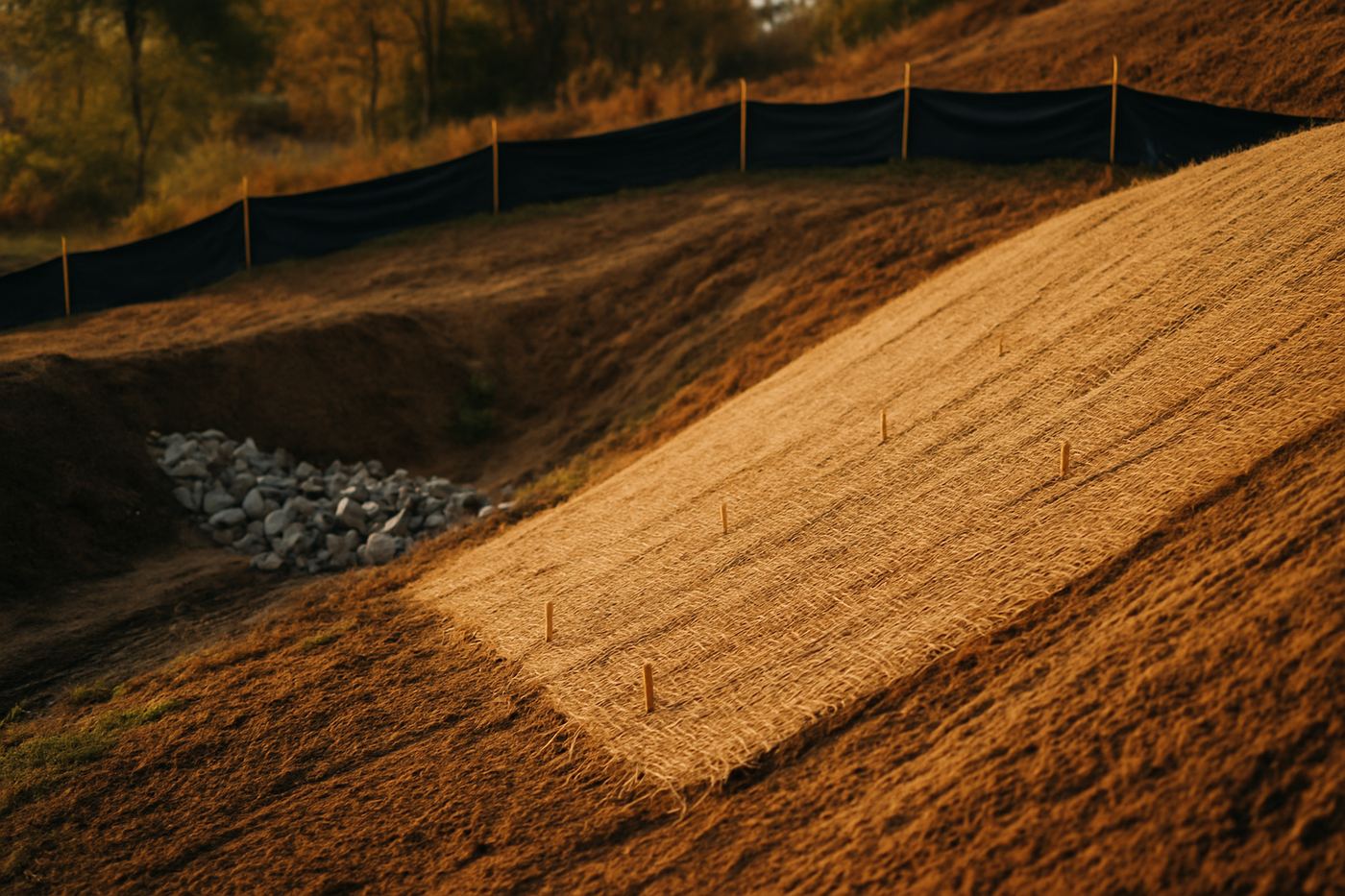
If you're disturbing more than an acre of ground in Tennessee or Georgia — and a surprising number of residential building lots cross that line — federal stormwater rules require an erosion and sediment control plan with on-the-ground BMPs (best management practices). Inspectors check for it; if it's not there, the project stops. We install and maintain silt fence, inlet protection, construction entrances, sediment traps, and slope stabilization across the Greater Chattanooga area, sized to the SWPPP (stormwater pollution prevention plan) on file with TDEC or the Georgia EPD.
Why erosion control matters
The dirt that washes off a construction site doesn't disappear. It goes into the nearest creek, choking the substrate and harming aquatic life — and into nearby properties, where it becomes the homeowner's problem. The federal Clean Water Act, administered by TDEC in Tennessee and the EPD in Georgia, requires sites disturbing 1+ acre to have an active SWPPP and to inspect/maintain the BMPs through construction.
Beyond the legal piece, good erosion control prevents:
- Sediment damage to neighbors' property and shared driveways
- Fines and stop-work orders (commonly $1,000-$10,000 per violation)
- Long-term soil loss on the build site that has to be replaced as topsoil
- Mud tracked onto public roads, which itself is a violation
What we install
- Silt fence along the down-slope perimeter, trenched into the ground 6 inches deep so water flows through the fabric instead of under it
- Construction entrance pads — 50-100 feet of clean #1 or #2 stone at the entry point, which knocks the mud off truck tires before they reach the road
- Inlet protection — fabric or stone bags around storm drain inlets to filter water entering the system
- Sediment traps and basins for larger sites or steeper slopes
- Diversion swales to route clean water around the disturbed area
- Slope stabilization — straw blankets, erosion control matting, or hydroseed on cut slopes
- Rock check dams in temporary ditches to slow water velocity
- Tracking maintenance — re-graveling the entrance, cleaning out silt fence, replacing damaged sections
When you need a SWPPP
Federal NPDES rules and TDEC's CGP (Construction General Permit) kick in at 1 acre of disturbance. Many jurisdictions in our area drop that threshold for hillside lots, lots adjacent to streams, or lots in regulated overlays. Quick check:
- Disturbing more than 1 acre? You need a SWPPP and a Notice of Intent (NOI) filed with TDEC or EPD.
- Disturbing less than 1 acre but part of a larger common-plan development? You still need a SWPPP.
- Less than 1 acre, isolated lot? Federal rules don't apply, but local rules might. Hamilton County and the City of Chattanooga have their own land disturbance rules.
When in doubt, ask. The cost of asking is zero; the cost of being wrong is a stop-work order.
Common projects
- New home construction sites (SWPPP coordination + BMP install)
- Subdivision developments (initial install + maintenance through buildout)
- Site grading jobs on hillside lots
- Driveway extensions or aprons that cross a streambank buffer
- Pond or pool excavation adjacent to creeks
- Storm restoration work after heavy rain damages an existing site
Inspections and maintenance
A SWPPP isn't a one-time install. The CGP requires:
- Weekly inspections documented in a log
- Inspections after every 0.5-inch rain event (Tennessee) or 0.5-inch in 24 hours (Georgia)
- Repair within 7 days of any deficiency noted
We can handle the install only, the install plus weekly inspections, or full SWPPP administration depending on what the project needs.
Free on-site estimate.
(228) 355-1539 example build
Frequently asked questions
Do I really need erosion control on a residential build?
If you're disturbing more than an acre, federally yes. Even on smaller lots, local rules often require silt fence along down-slope edges. And if your sediment washes onto a neighbor or into a creek, you're liable regardless of the size.
How long does silt fence last?
A properly installed silt fence with the bottom 6 inches trenched and back-filled typically performs 6-12 months. Sun exposure degrades the fabric; sediment loading eventually clogs the pores. We replace deteriorated sections as part of maintenance.
What's the difference between silt fence and a sediment trap?
Silt fence is a fabric barrier installed at the down-slope edge to filter sheet flow. A sediment trap is an excavated basin sized to capture concentrated runoff from a larger drainage area, with a stone outlet to release clean water. For steeper sites or sites with concentrated discharge points, you need both.
Can you handle the SWPPP filing itself?
We work with TDEC-certified inspectors and engineers for SWPPP development and filing. We coordinate the install with their plan. For the actual Notice of Intent filing, we usually leave that to the certified plan author.
What's a construction entrance?
A pad of clean stone — typically #1 or #2 limestone — at the only entry/exit point on the site, designed to knock the mud off truck tires before they hit the public road. Required on most permitted construction sites. We install and re-stone as the project progresses.
When do you remove the erosion control?
After final stabilization — meaning the disturbed areas have 70% perennial vegetative cover (or equivalent stabilization). We remove silt fence, restore the trench line, and certify the site for SWPPP closure.
Other services in this build
Basement Excavation
Building Pads & House Pads
Catch Basin Installation
Commercial Parking Lot Grading
Concrete Driveway Installation
Concrete Driveway Repair
Concrete Sidewalks, Patios & Flatwork
Concrete Forming & Pouring
Crawl Space Excavation
Creek Bank Stabilization
Culvert Installation
Demolition (Residential & Light Commercial)
Other service areas
TN
GA