
Example builds › L&S Excavation › Services › Concrete Driveway Installation
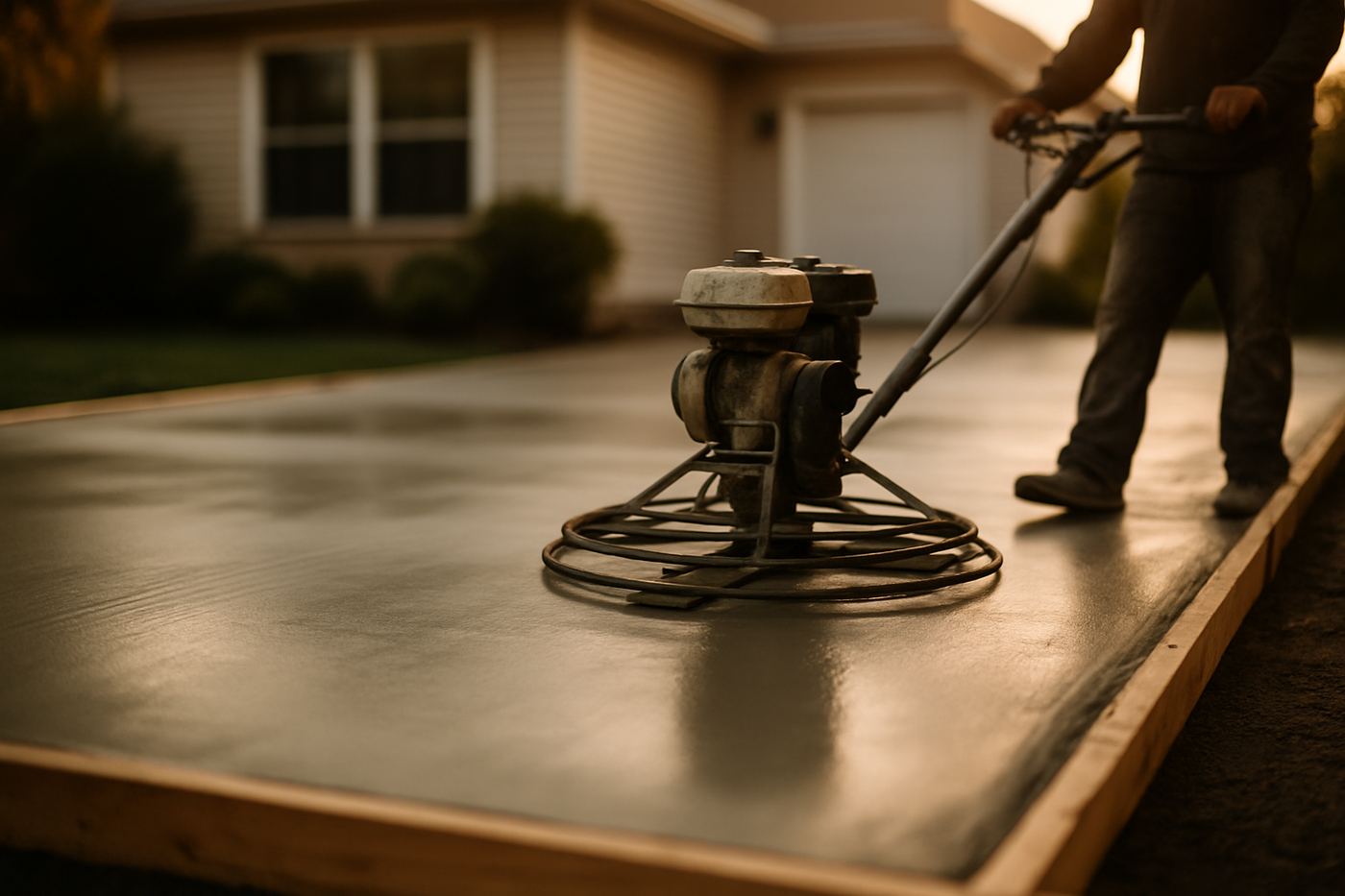
A concrete driveway is one of the largest single pours on a residential property — and the one that gets seen and used every day for decades. Done right, it lasts 30-50 years and looks the same on year 25 as it did on year 1. Done wrong, it cracks across the middle by the second winter. We install concrete driveways across the Greater Chattanooga area with the same approach we use on every pour: subgrade first, reinforcement always, joints planned, finish to spec.
What's included
- Layout and stakeout of the driveway footprint with proper grade falls
- Site excavation and stripping of organic topsoil and unsuitable material
- Subgrade compaction to 95% standard Proctor
- Crushed-stone base course — typically 4-6 inches of compacted #57 or crusher run
- Edge forms set to elevation, including the apron transition to the road
- Rebar grid or wire mesh sized to the loading
- Vapor barrier under attached or heated slabs where called for
- 4,000 psi air-entrained concrete mix for our freeze/thaw zone
- Control joints cut at the right spacing (typically every 10-12 feet)
- Broom finish standard; smooth, salt, exposed aggregate, or stamped options
- Cure with wet-cover or membrane curing compound for the first 7 days
Concrete vs. asphalt vs. gravel
We build all three. The right choice depends on use, budget, and how the driveway connects to the rest of the property:
- Concrete — 30-50 year service life, highest upfront cost, lowest maintenance, looks finished
- Asphalt — 15-25 year service life, mid-cost, periodic seal-coating required (we don't pave asphalt — we coordinate with paving sub if needed)
- Gravel — 5-15 year service life with periodic top-up, lowest cost, rural and rustic look
For most residential builds in Hamilton County with a 50-100 foot driveway, concrete is the right long-term call when the budget allows.
Thickness, reinforcement, and slope
A residential concrete driveway in our area is typically:
- 4 inches thick for cars and light SUVs
- 5-6 inches for trucks, dual-axle vehicles, or RVs
- 6 inches with #4 rebar grid for heavy loads (dump trucks, equipment trailers)
- 2% minimum slope away from the house and toward the street, ditch, or yard
We hit each spec. We don't pour 3.5 inches and hope.
Why concrete driveways crack
Some hairline cracking in any concrete pour is normal. The cracks that ruin a driveway are the ones that telegraph through the slab in the first two years. The usual culprits:
1. Insufficient subgrade prep. Soft spots under the slab settle, and the slab cracks where the support fails. 2. Missing or wrong control joints. Concrete shrinks as it cures. If we don't tell it where to crack with joints, it picks its own spot. 3. Pouring on saturated subgrade or in extreme weather. Hot summer pours need timing; cold winter pours need protection. 4. Wrong mix design. Our freeze/thaw zone needs air-entrained concrete. Plain mix from a regional plant will spall by year five. 5. Skipped curing. Concrete that loses water too fast in the first 7 days cracks for the next 50.
We don't skip any of those.
The apron — where most driveways fail first
The transition from the driveway to the public road or street curb is where the most stress concentrates: heavy vehicle wheel loads, the angle change, the seam between your concrete and the public asphalt or curb. The apron usually needs:
- 6-inch thickness instead of 4
- Heavier rebar reinforcement
- A clean isolation joint between your slab and the curb
- A permit from the road department for the connection (we file it)
Free on-site estimate.
(228) 355-1539 example build
Frequently asked questions
How long until I can drive on a new concrete driveway?
24 hours for foot traffic, 72 hours for light vehicles, 7 days before parking heavy trucks or trailers. Full design strength is 28 days. Patience here is what keeps the cracks invisible.
Do I need rebar in my driveway?
For residential driveways carrying passenger vehicles, wire mesh is fine. Rebar makes sense for anything that takes truck or trailer weight or sits on soils with poor bearing. We'll measure and recommend.
What's the difference between 3,000 and 4,000 psi mix?
3,000 psi is the residential default in mild climates. 4,000 psi with air-entrainment is what we use in the Greater Chattanooga freeze/thaw zone — the air voids let water expand on freeze without spalling the surface. The cost difference is small; the lifespan difference is decades.
Can you tear out my old driveway and pour a new one?
Yes. We handle the demolition, haul-off, subgrade reconditioning, and new pour. Often the existing base is salvageable, which saves on stone — we'll evaluate before quoting.
How wide should a residential driveway be?
10-12 feet for a single car path, 16-18 feet for two cars side-by-side. The apron at the street can flare wider for easier turn-in. We size to the lot and the use.
Can you do stamped or stained concrete?
Yes. Stamped concrete uses patterned mats pressed into the wet pour; integral colors or topical stains are added during or after. For high-end decorative work we coordinate with a finish specialist.
Do you need a permit for a new driveway?
A driveway apron that connects to a public road requires a driveway encroachment permit from the county or city road department. Replacement in-place sometimes doesn't, but adding width or changing the apron location usually does. We file what's needed.
Other services in this build
Basement Excavation
Building Pads & House Pads
Catch Basin Installation
Commercial Parking Lot Grading
Concrete Driveway Repair
Concrete Sidewalks, Patios & Flatwork
Concrete Forming & Pouring
Crawl Space Excavation
Creek Bank Stabilization
Culvert Installation
Demolition (Residential & Light Commercial)
Driveway Building (Gravel Driveways)
Other service areas
TN
GA